
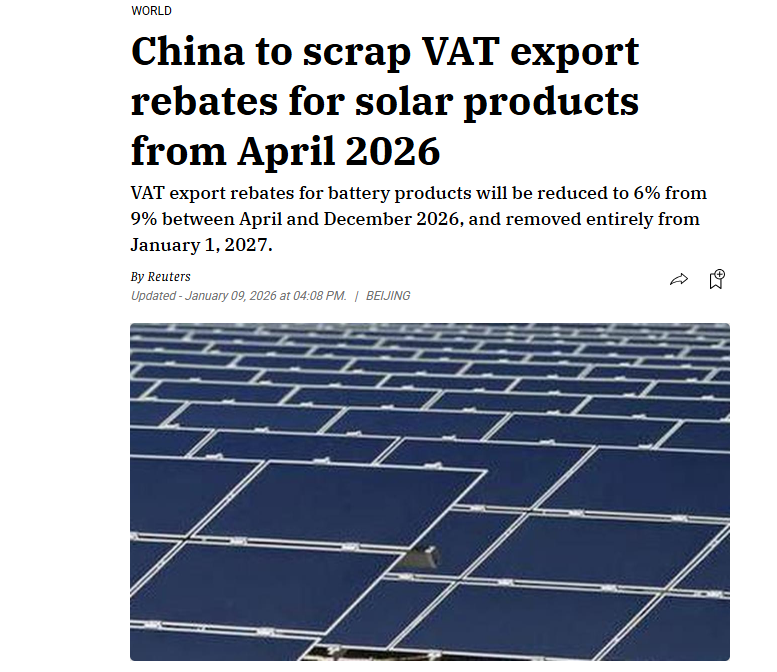
China has officially announced that export tax rebates for solar panels will be cancelled starting April 1, 2026. This major policy shift is expected to have a direct and lasting impact on global solar pricing.
At the same time, raw material costs are continuing to rise. Key commodities such as silver, copper, and lithium—essential materials for solar modules, inverters, and lithium batteries—have seen sustained price increases due to supply constraints and growing global demand.
As a result, solar panels, inverters, and battery system prices are entering a new upward cycle. The era of “cheap solar” is coming to an end, and cost pressure across the supply chain is becoming unavoidable.
For installers, distributors, and project developers, this means higher procurement risks, tighter margins, and longer decision cycles. Buyers who delay may face higher prices, reduced availability, or extended lead times in the coming months.
To stay competitive, securing your solar and energy storage supply chain early is more important than ever. Working with stable manufacturers, confirming orders in advance, and locking in pricing where possible can help mitigate future cost increases.
Now is the critical window to plan ahead, protect margins, and ensure project continuity in 2026 and beyond.
The “Perfect Storm” for Renewables: China Cancels Export Tax Rebates Amidst Raw Material Inflation
Date: January 9, 2026
Category: Market Trends / Solar Supply Chain News
Cheaper Solar Prices Are Ending — Here’s What Buyers Need to Know
If you’ve been waiting for solar panel or battery prices to fall further, the opportunity is quickly disappearing.
China has officially announced a major policy shift that will reshape global solar pricing. Starting April 1, 2026, export tax rebates for solar PV products will be fully cancelled, while lithium battery export rebates will be reduced and gradually phased out.
Combined with rising silver, copper, and lithium prices, this marks the end of the two-year deflationary cycle in the solar and energy storage market.
What Changed in China’s Export Policy?
For years, China’s export tax rebates helped manufacturers maintain competitive pricing worldwide. That support is now being withdrawn.
-
Solar PV products:
Export tax rebates cancelled effective April 1, 2026 -
Lithium batteries:
-
Rebate reduction starting April 1, 2026
-
Full cancellation from July 1, 2026
-
Impact:
Without the former 9%–13% tax rebate, export prices (FOB/CIF) must rise. A 10%–15% price increase is unavoidable for most PV products.
The Second Pressure: Rising Raw Material Costs
Policy is only part of the story. Since late 2025, global commodity prices have risen simultaneously:
-
Silver: Higher PV cell production costs
-
Copper: Increased costs for cables, inverters, and wiring
-
Lithium: Rebounding prices driving battery cost increases
Manufacturers are now facing policy-driven and market-driven cost increases at the same time, leaving no room for further price reductions.
What This Means for 2026 Pricing
-
Now – March 31, 2026:
Rush orders will tighten factory capacity and delivery schedules. -
From April 1, 2026:
Solar module prices will reset higher, with 10%–15% increases. -
Battery pricing:
Gradual increases in April and again in July.
Bottom line: Solar and battery prices will rise in 2026.
How to Prepare Now
-
Lock in orders early to ship before the April 1 deadline
-
Advance procurement for Q2–Q3 projects into Q1
-
Secure raw material pricing by placing deposits early to hedge against further increases
Conclusion
The era of ultra-cheap solar is over. A new pricing cycle—driven by policy changes and commodity inflation—has begun.
Planning ahead is the best way to protect margins and ensure supply continuity.
Contact our team now to secure Q1 production slots before prices reset in April.